
Most businesses would describe themselves as increasingly digital. And yet, walk into almost any office in the UK and you will find the same thing: filing cabinets that no longer close properly, archive rooms that have quietly become storage rooms, and boxes stacked in corners waiting for someone to decide what to do with them.
Despite increasingly digital workplaces, the ease with which paper can be produced means most businesses still face growing volumes of physical records. Contracts, financial statements, patient files, HR documentation, clinical trial data, the paper keeps accumulating, and the legal obligation to retain much of it does not disappear just because your team has moved to the cloud.
But the conversation around document management has changed considerably in recent years. In an age of AI-powered business tools, tightening data privacy legislation, and genuine corporate pressure around sustainability, how you store and eventually destroy your records is not simply a matter of compliance and convenience. It is a reflection of how seriously you take security, your obligations to the environment, and the future-readiness of your organisation.
This post sets out what good document management actually looks like today, from secure storage through to confidential destruction, and why the end of a document’s life is where some of the most interesting thinking is happening.
Why the Paper “Problem” Is Not Going Away
Financial data must be retained for UK legal reasons. Depending on your sector, there are additional regulatory requirements governing how long specific categories of records must be kept and in what conditions they must be stored. Legal and financial firms, life sciences and pharmaceutical businesses, healthcare providers, educational establishments and public sector organisations all operate under their own frameworks, and the consequences of getting it wrong can be significant.
Managing this volume of documentation in-house is costly, time consuming, and occupies space that businesses could put to far better use. A dedicated archive store or repurposed meeting room is not a long-term solution. It introduces risk, it creates operational friction, and it rarely meets the security standards that regulators expect.
Off-site archive storage exists to solve this problem. It frees up office space while maintaining quick, easy access to the documents you need, and it places the responsibility for security and compliance with specialists who do this full-time. It is however, a more cost-effective solution compared to digitising
The business case is straightforward: archive storage provides the solution to storing large volumes of documents that are required for legal and compliance reasons but are not required for day-to-day access. It is more cost-effective than managing records in-house, and it significantly reduces business risk.
What Good Document Storage Looks Like
At Ardington Archives, storage environments are built to protect your documents. Bespoke storage rooms meet BS 4971 standards, with premium vault options offering temperature and humidity control for the most sensitive records, including those governed by Good Clinical Practice guidelines. Where you reference DIN level 3, could you also please add reference to BS EN 15713:2023.
Not all archive storage is created equal. The standards that matter are well established, and a reputable provider should be able to demonstrate compliance with them clearly.
At Ardington Archives, storage environments are built to BS 4971 standards, with premium vault options offering temperature and humidity control for the most sensitive records, including those governed by Good Clinical Practice guidelines. The facilities are locked at all times, alarmed, and accessible only to authorised staff. All key personnel are DBS checked as a minimum, and most hold Non-Police Personnel Vetted (NPPV3) clearance, a standard more commonly associated with policing and security services. Every box is security banded on arrival and given a unique barcode identification number, and every movement is recorded both electronically and manually to ensure full traceability from initial collection through to end-of-life destruction.
Documents can be returned physically or via digital scan, uploaded to a secure portal for download at a time that suits the client.
That digital retrieval option matters more than it might initially appear, and it connects to something that is reshaping how businesses think about their archives altogether.
AI is changing what archive access needs to look like
AI-powered business tools, from document analysis platforms to regulatory monitoring systems to knowledge management software, are only as useful as the information they can access. Businesses are increasingly building workflows that require their historical records to be searchable, indexable, and retrievable on demand. A box sitting in an archive room with a handwritten label is invisible to those systems. A document scanned, indexed, and available through a secure online portal is not.
Secure online document storage, accessible 24 hours a day from any internet-connected device, means archived records can feed into wider information workflows rather than sitting in a black box. For organisations in sectors where data review, audit, or regulatory submission is a regular reality, this is no longer a nice-to-have. It is a practical necessity.
The shift is not about replacing physical storage. Most businesses need a sensible combination of both. It is about ensuring that the physical archive does not become a barrier to the kind of fast, intelligent information retrieval that modern organisations depend upon.
The Document Lifecycle: Knowing When to Let Go
Every document has a lifespan. For some, that lifespan is defined by statute. For others, it is set by internal policy or sector-specific guidance. Once that lifespan is up, retaining the document unnecessarily does not protect the business. It creates risk.
Unnecessary retention of personal data is a data protection issue. Holding confidential information beyond its useful life increases the potential impact of a data breach. It also creates clutter that makes genuine retrieval slower and more error-prone.
Good archive management therefore includes a clear plan for destruction, not just a plan for storage.
At Ardington Archives, clients are asked to assign a review date to each box at the point it is deposited. A quarterly report is then issued identifying which boxes are approaching their review date, and clients can decide whether to continue storing or proceed to confidential destruction. Any instruction to destroy must be authorised by a pre-assigned signatory, maintaining a clear chain of custody throughout.
On completion of the destruction process, a certificate of destruction is issued. This provides the audit trail that regulators and internal governance teams require.
This is a well-established process, but it is worth noting that AI tools are beginning to change how businesses approach it. Intelligent document management platforms can flag retention deadlines automatically, monitor for changes in regulatory requirements, and prompt destruction scheduling without requiring manual intervention. The human authorisation step remains essential, and rightly so. But the administrative burden of lifecycle planning is becoming significantly lighter for businesses that choose to embrace these tools.
Confidential Destruction: What It Actually Involves
The phrase “confidential destruction” is sometimes treated as shorthand for putting documents through a shredder. The reality involves considerably more rigour than that, and the distinction matters.
Any document that is no longer required should be securely destroyed. This is not simply good practice. It is a legal requirement that anyone transporting documents to a destruction point on behalf of a company must be a registered waste carrier. A business that hands confidential records to an unregistered third party for disposal is not compliant, regardless of what that third party claims to do with the material.
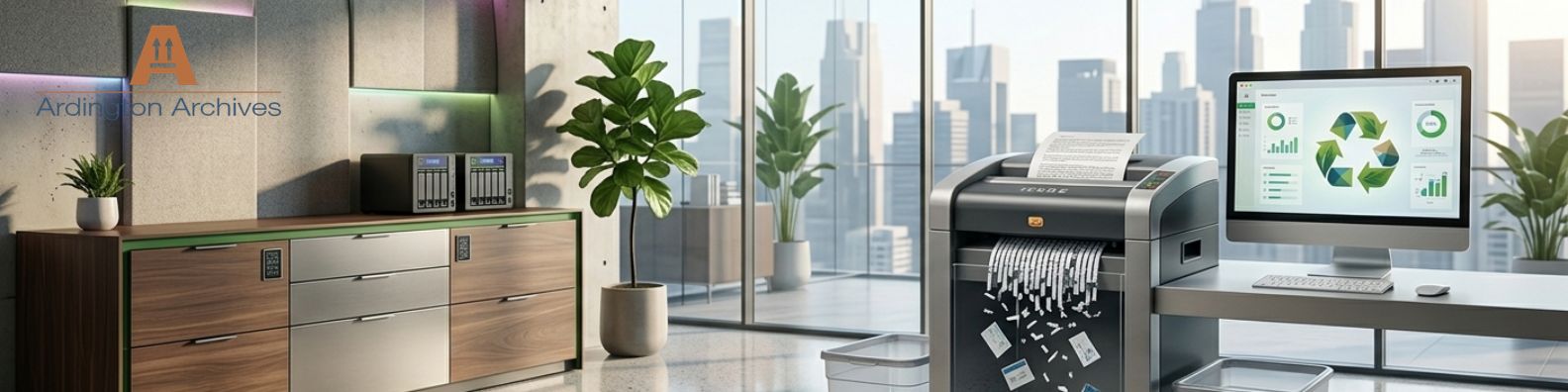
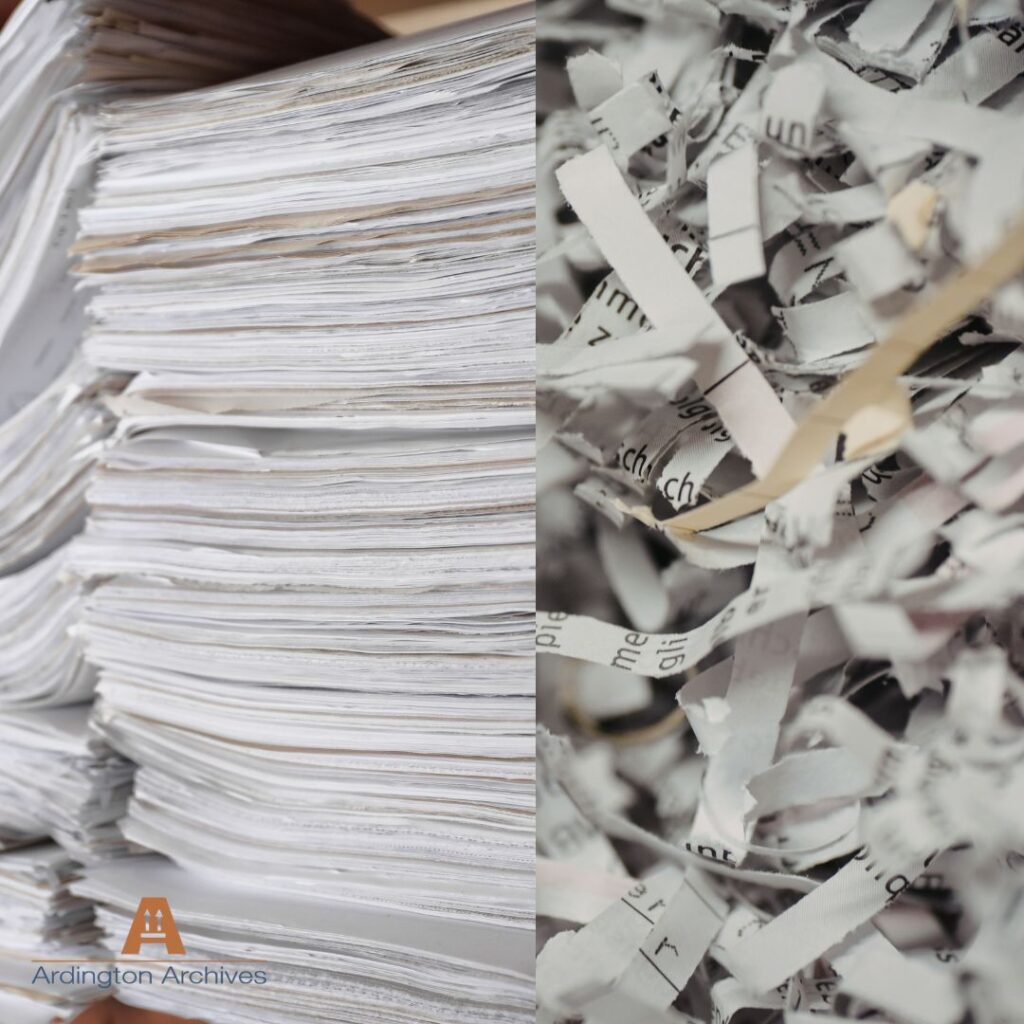
At Ardington Archives, the process begins with discreet collection in unmarked vehicles. Documents are then shredded twice, to DIN level 3, before being pulped and recycled. The chain of custody is maintained throughout, and a certificate of destruction is provided on completion.
The service is available as a standalone offering for businesses that do not use ongoing storage. It is also available as an on-site service where clients prefer destruction to take place at their premises. For offices that generate a regular flow of sensitive paper waste between collections, lockable confidential waste cabinets are available to ensure that material is held securely until collection.
Electronic media requires a different approach
Paper is not the only thing that needs to be destroyed. Hard drives, USB storage devices, CDs and DVDs all hold confidential information, and the approach required is quite different from document shredding.
Deleting files and directories from a hard drive does not fully remove the underlying data. Without physical destruction, that data remains potentially recoverable. Compliance with the Data Protection Act requires that electronic media containing personal or confidential data is physically destroyed, not simply wiped.
Ardington Archives provides a secure destruction service for electronic media, warranted in compliance with appropriate standards and disposed of in accordance with the Waste Electrical and Electronic Equipment (WEEE) Directive. All destroyed media is shredded to ensure the data has been permanently and irrecoverably destroyed.
The Sustainability Story That Does Not Get Told Often Enough
Confidential destruction is overwhelmingly discussed in terms of security and compliance. The sustainability dimension is underappreciated, and it deserves more attention.
When documents stored at Ardington Archives reach the end of their retention period and are approved for destruction, the shredded paper is not sent to landfill. It is pulped and recycled into toilet tissue, giving the material a second useful life. The destruction of your old contracts, financial records, and HR files is, quite literally, contributing to something.
For electronic media, disposal under the WEEE Directive ensures that components are handled responsibly and that recoverable materials are returned to the supply chain rather than lost to landfill.
The archive boxes themselves are part of this picture too. Ardington Archives uses custom-designed boxes made from high-content recycled board, with a double-thickness skin for durability and a longer usable life than standard alternatives. They are pH neutral to protect document integrity, and supplied flat-packed to reduce transport volume.
The preference for digital retrieval, uploading scanned documents to a secure portal rather than physically delivering boxes, is also an environmental consideration. Keeping vans off the road is an explicit part of why Ardington Archives treats this as its preferred retrieval method.
And there is a broader point here that is worth making directly. Consolidating archive management with a specialist provider means consolidating transport runs, waste streams, and disposal processes. A business managing its own records in-house is effectively running its own small-scale logistics and waste operation, often inefficiently and without the economies of scale that a dedicated provider can bring. Outsourcing to a specialist does not just free up office space. It reduces the overall environmental footprint associated with managing and eventually disposing of those records.
Where AI connects to sustainability in document management
This might seem like an unlikely pairing, but it is a real one. AI-assisted document management can help businesses identify records that are eligible for destruction sooner, reducing the time and physical resources associated with holding documents beyond their useful life. Smarter retention scheduling means less unnecessary storage, fewer transport movements, and less waste generated at the point of destruction. Intelligent lifecycle management, driven by AI tools that surface records for review automatically, is one of the more practical ways that businesses can reduce the environmental cost of their information management.
What a Managed Document Storage Relationship Looks Like in Practice
The full lifecycle of a document, from collection to destruction, is something a good archive partner should be able to manage without placing any significant burden on the client.
At Ardington Archives, the process works as follows. Documents are collected in unmarked vehicles and transported to secure facilities in Oxfordshire, where they are barcoded on arrival and allocated a space on racking. Each box is given a unique identifier that allows it to be tracked throughout its time in storage. A review date is assigned at the point of deposit. Quarterly reporting keeps clients informed of which boxes are approaching that date. On instruction from an authorised signatory, boxes are retrieved from storage and sent for confidential destruction. A certificate of destruction is issued.
The process is designed to be transparent, auditable, and straightforward for the client to oversee without needing to be involved in the operational detail.
Ardington Archives has been providing document storage and archiving services for over 30 years, working with businesses across legal, financial, life sciences, pharmaceutical, healthcare, education, and public sector organisations. The service is built around security, compliance, and ease of access, with a retrieval capability that operates to next working day timescales across the UK.
Frequently Asked Questions
What happens to documents after confidential destruction? Documents are shredded twice to DIN level 3, then pulped and recycled into toilet tissue. They are not sent to landfill. A certificate of destruction is issued to confirm the process has been completed.
Is confidential destruction environmentally friendly? Yes. The destruction process at Ardington Archives is designed to be both secure and sustainable. Shredded paper is pulped and recycled rather than disposed of in landfill. Electronic media is destroyed and disposed of in compliance with the WEEE Directive, ensuring responsible materials recovery.
Do I need to use ongoing storage to access confidential destruction? No. Confidential destruction is available as a standalone service for businesses and private individuals. An on-site shredding service is also available for clients who prefer destruction to take place at their premises.
How do I know destruction has taken place? A certificate of destruction is issued on completion of the process, providing a clear audit trail for regulatory and governance purposes.
What happens to electronic media such as hard drives? Electronic media is physically destroyed rather than deleted or wiped, in compliance with the Data Protection Act. All destroyed media is warranted against appropriate standards and disposed of under the WEEE Directive.
The End of a Document’s Life Is Not an Afterthought
A well-managed document lifecycle is not a back-office function. It is part of how a responsible, future-facing business operates. Getting storage right protects the business from security risk and regulatory exposure. Getting retrieval right means that information is accessible when it is needed, including by the AI-powered tools that are increasingly central to how organisations make decisions. And getting destruction right closes the loop in a way that is both legally sound and, with the right partner, genuinely sustainable.
The end of a document’s life, handled properly, is not simply the disposal of waste. It is the beginning of something else.
To discuss your document storage and confidential destruction requirements, contact Ardington Archives on 01367 718710 or at enquiries@ardingtonarchives.co.uk.
Ardington Archives provides secure document storage, confidential destruction, document scanning and digital retrieval services from its facilities in Oxfordshire. Find out more about our confidential destruction service, secure archive environments, document retrieval options, and secure online document storage.